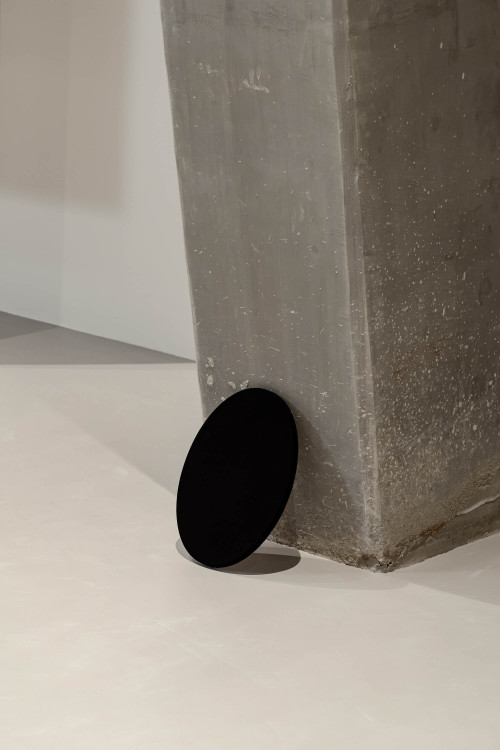
Deductive Object | 2025
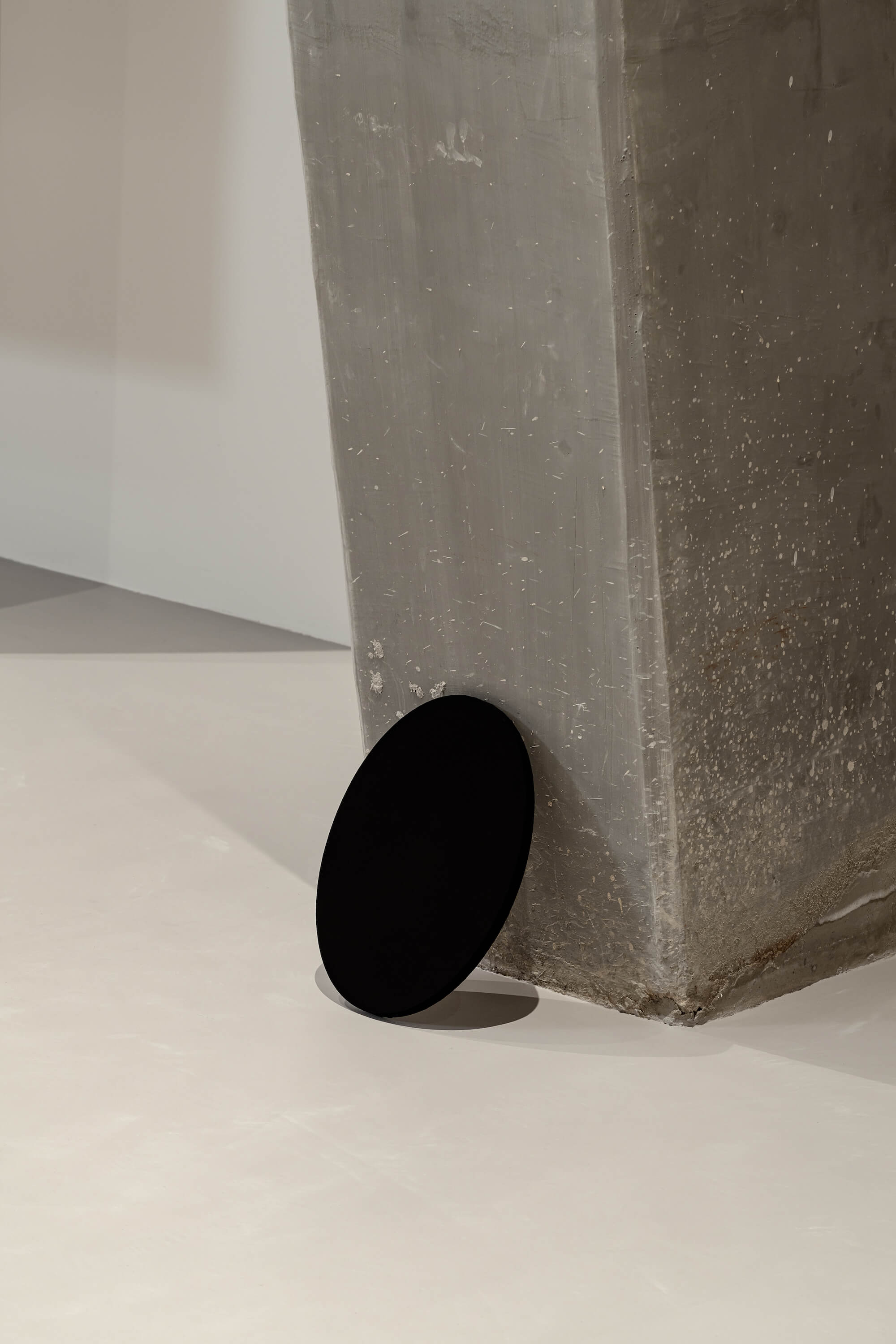
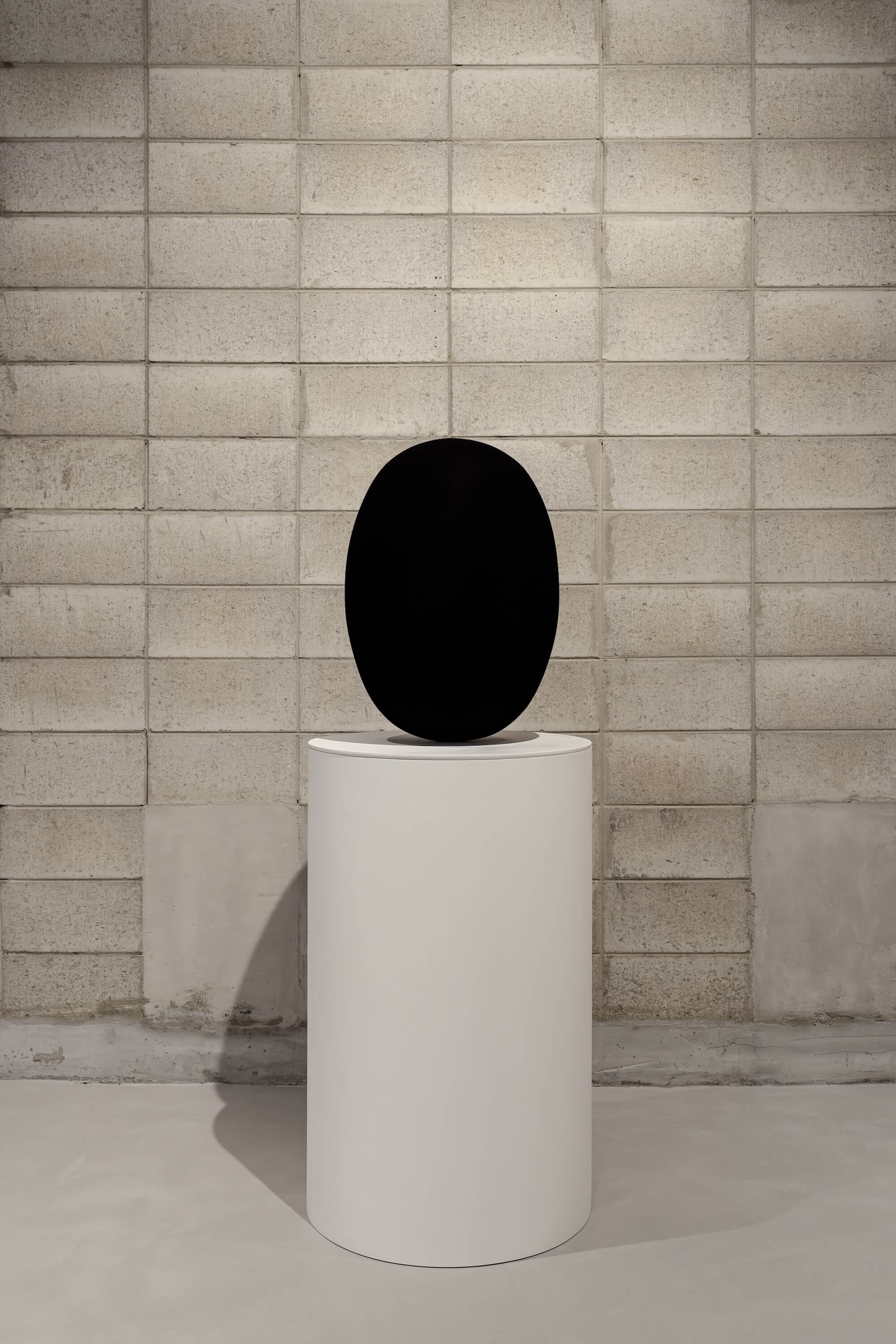
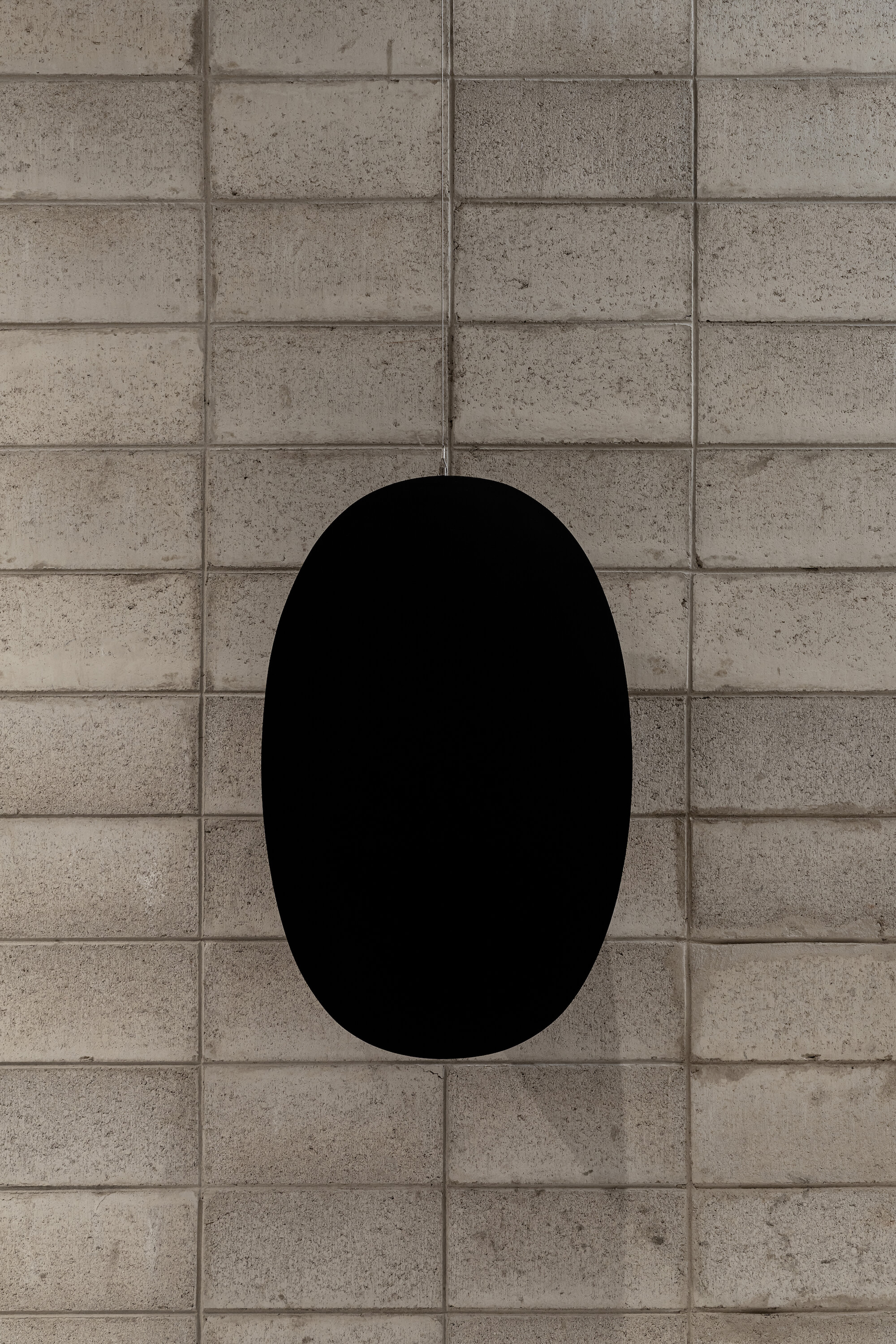
Deductive Object
Deductive Object (2025)
This scaled version of Deductive Object maintains the conceptual framework of Kimsooja’s original large-scale sculpture while rearticulating its formal presence. The work takes its form from the brahmanda stone of India, known as the “cosmic egg.” The cosmic egg symbolizes totality, encompassing both birth and death. This work may be perceived as a bottari bundle or as the body itself. Often suspended above a mirror, the black stone absorbs surrounding light, and this installation may likewise be understood “painting” as an act of “wrapping” of this elliptical sculpture.
Photo by Shim Kyuho
Installations at Studio Kimsooja, Seoul
(Left to Right:)
1 Kimsooja, Deductive Object, 2025, black paint on linen canvas, 40 x 30 cm
2 Kimsooja, Deductive Object, 2025, black paint on cast, base, 90 x 57 cm
3 Kimsooja, Deductive Object, 2025, black paint on cast, 90 x 57 cm
Meta Painting – The Grid | 2025
Meta Painting – The Grid
Meta Painting – The Grid (2025)
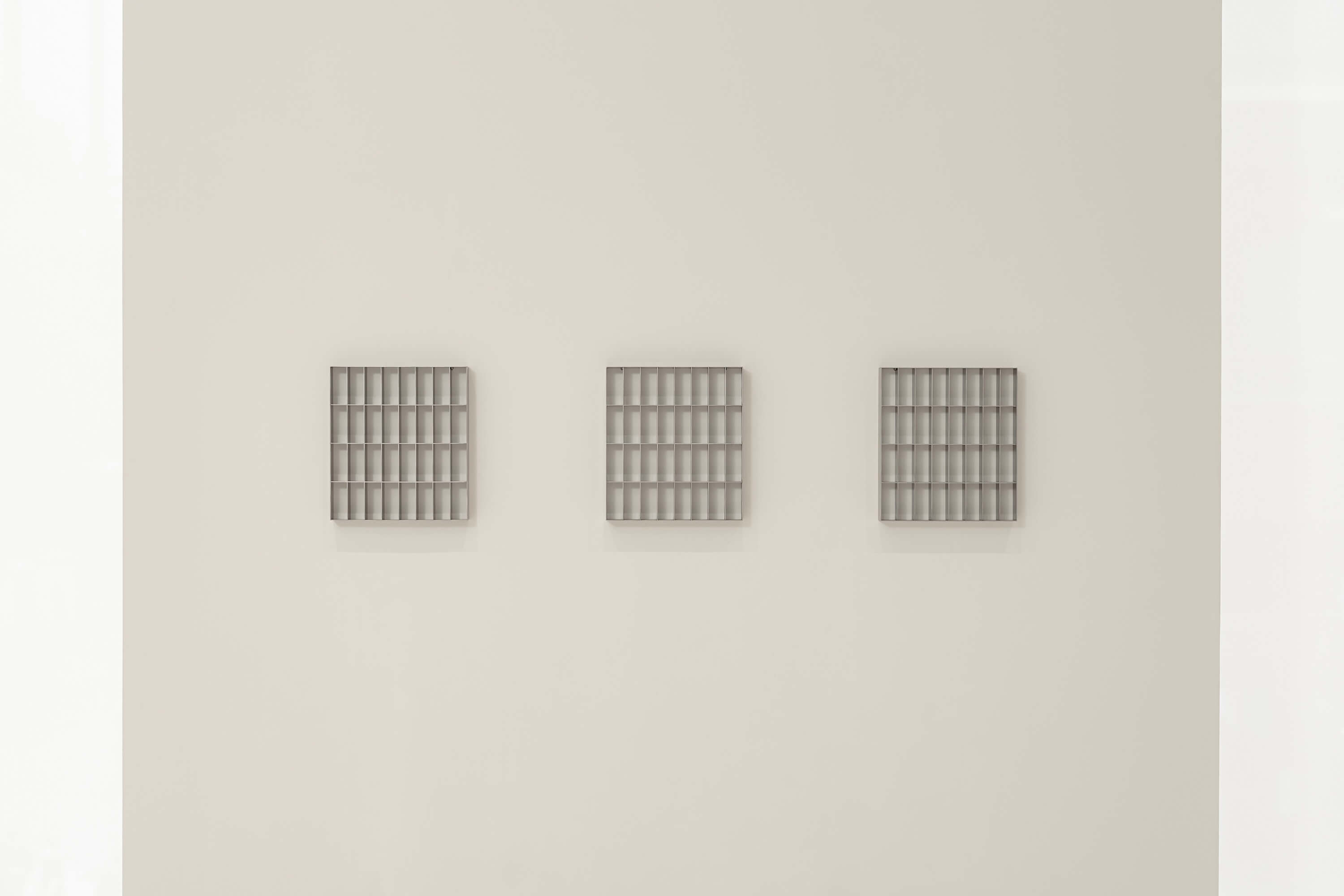
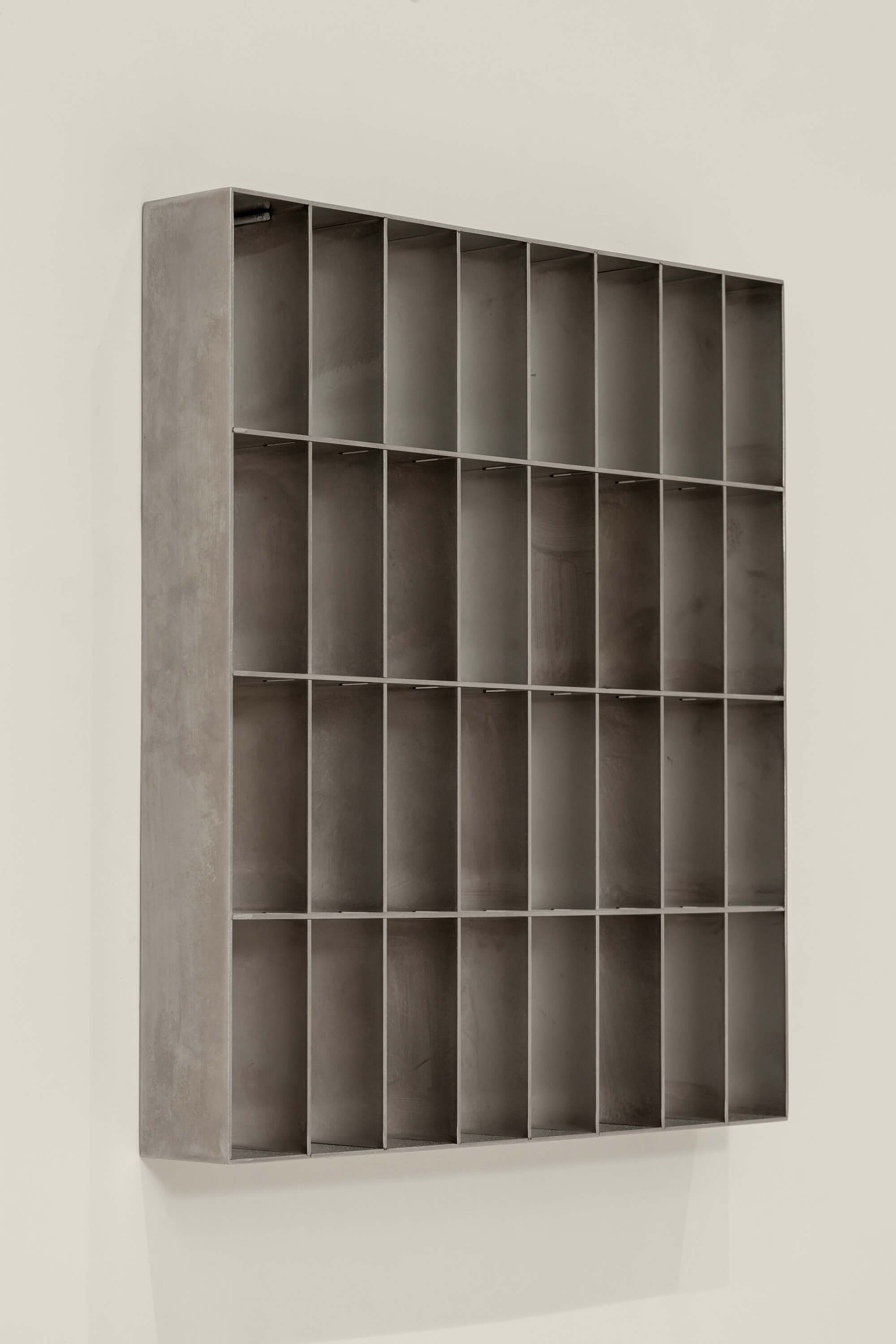
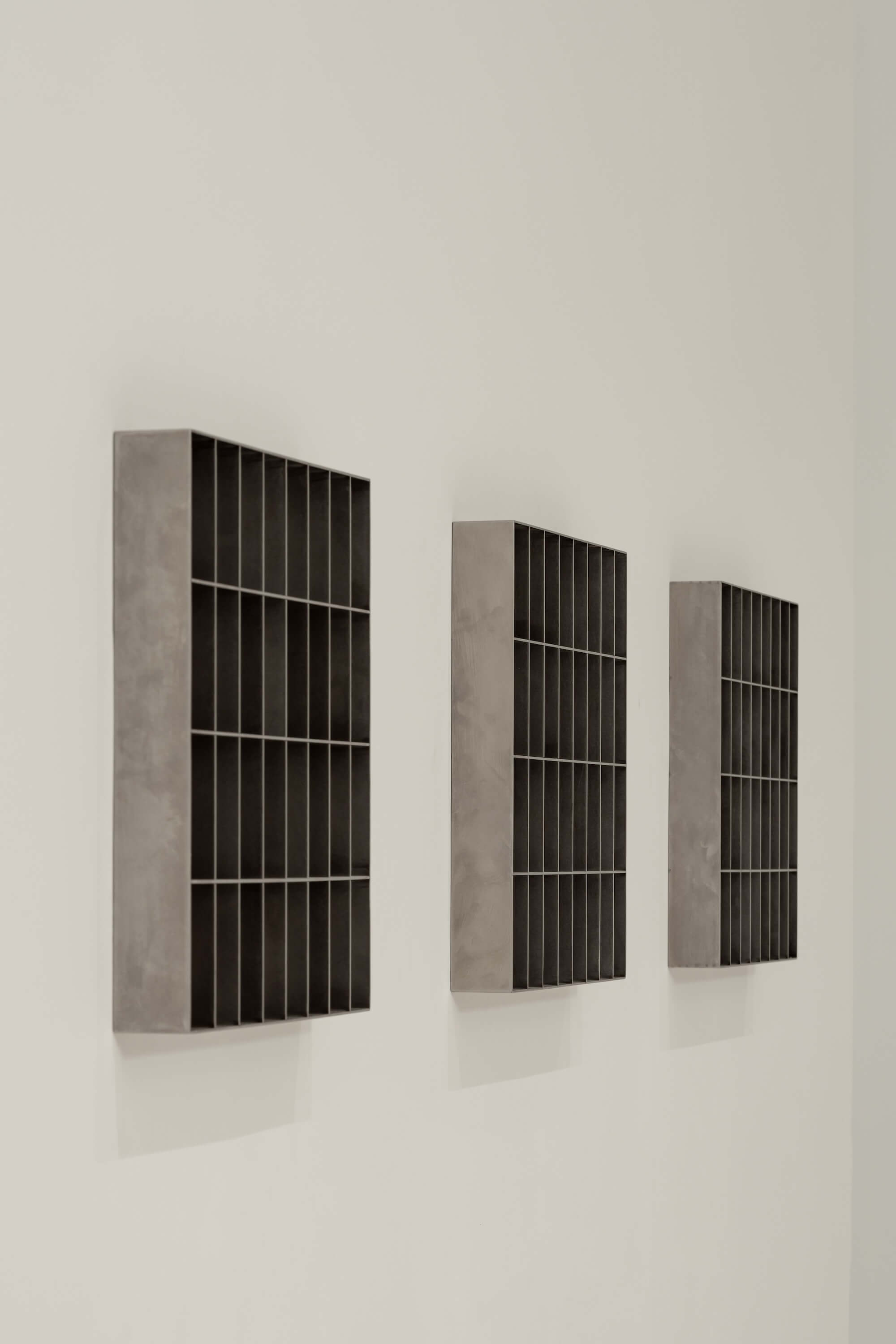
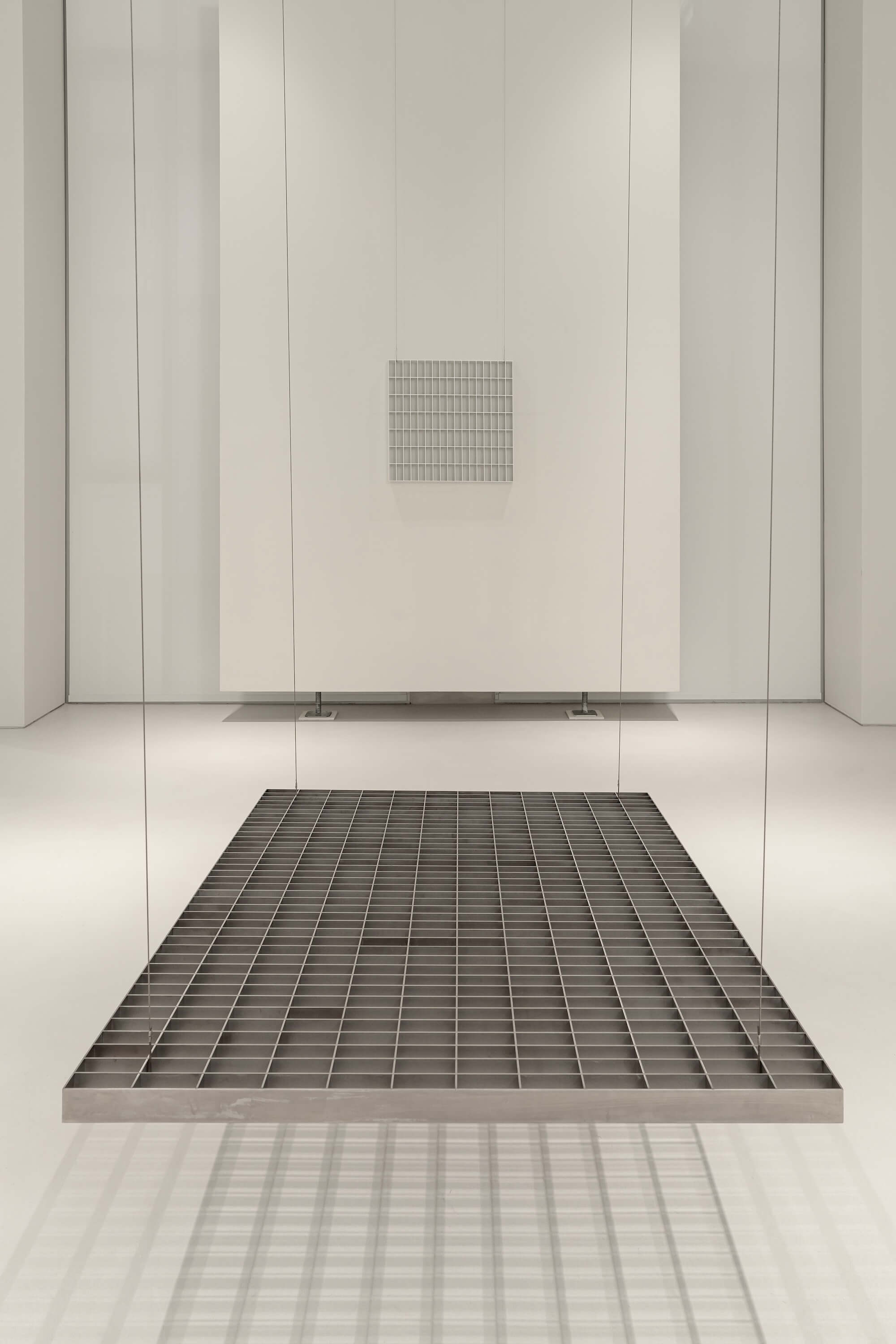
The gridded composition of the suspended works function both as a spatial framework and a contemplative drawn surface. Developed in collaboration with Jaeho Chong, these pieces built on Kimsooja's earlier object-based works, such as her textile-wrapped wooden window frames, or letterbox, where everyday forms are reimagined through acts of deduction and unfolding. Here, the grid becomes more than a visual structure: it serves as a meditative system of repetition and subtle variation of vertical and horizontal lines and surfaces. Extending Kimsooja’s longstanding exploration of verticality and horizontality as structuring axis between the grounded and the transcendent, this new series incorporates principles of seriality and modular construction. Suspended just off the wall, they occupy a liminal space between drawing and sculpture, inviting close attention to rhythm, form and intimacy through its quiet geometry.
Photo by Shim Kyuho
Installations at Studio Kimsooja, Seoul
(Left to Right:)
1 Kimsooja, Meta Painting – The Grid, 2025, steel grid, each 36 x 32 x 5 cm
2 - 3 Kimsooja, Meta Painting – The Grid, 2025, steel grid, each 36 x 32 x 5 cm
4 Kimsooja, Meta Painting – The Grid, 2025, steel grid, 160 x 109 x 5 cm, Meta Painting – The Grid, 2025, steel grid, paint, 64 x 70 x 5 cm
Meta Painting – Glass Swatches | 2025
Meta Painting – Glass Swatches
Meta Painting – Glass Swatches (2025)
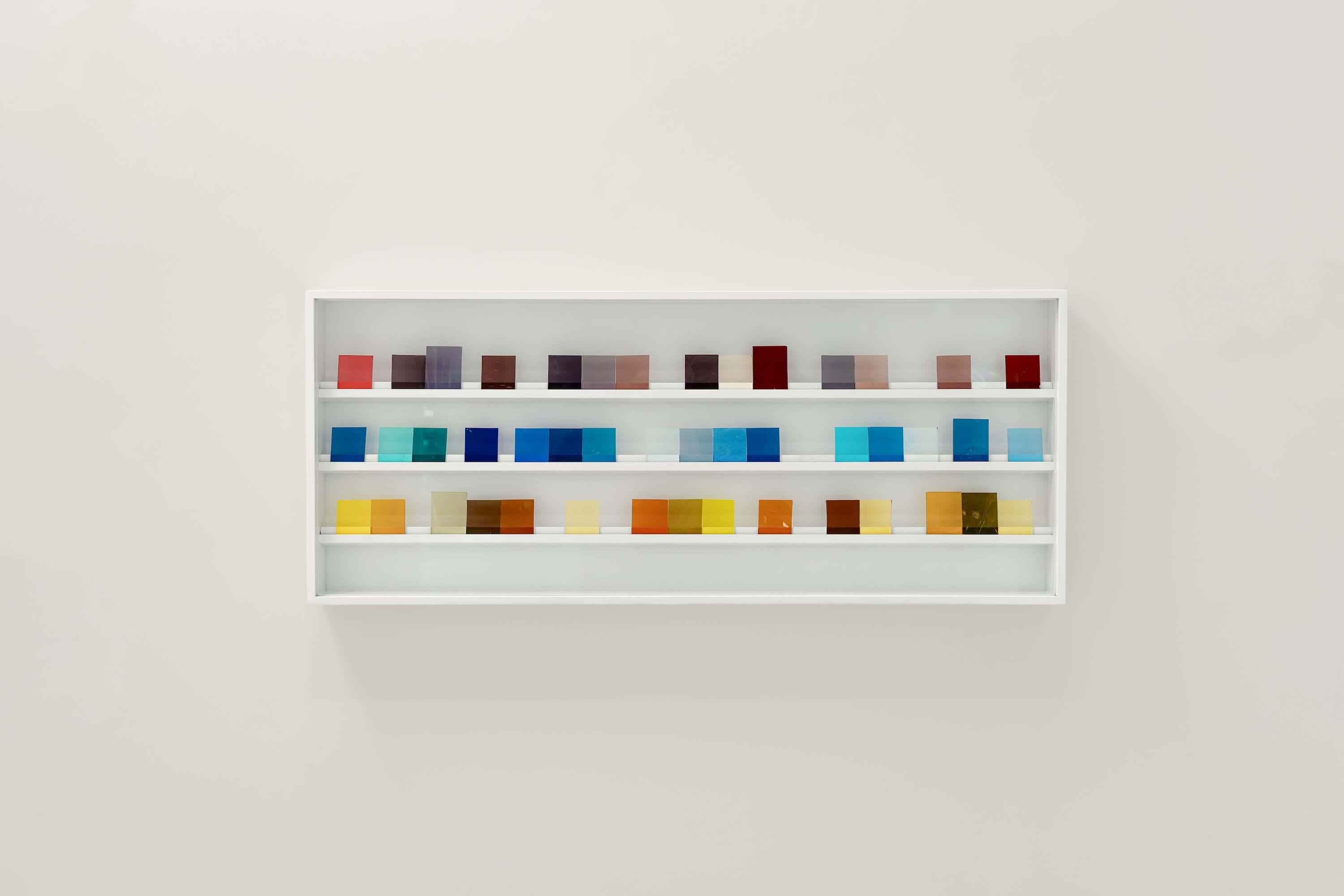
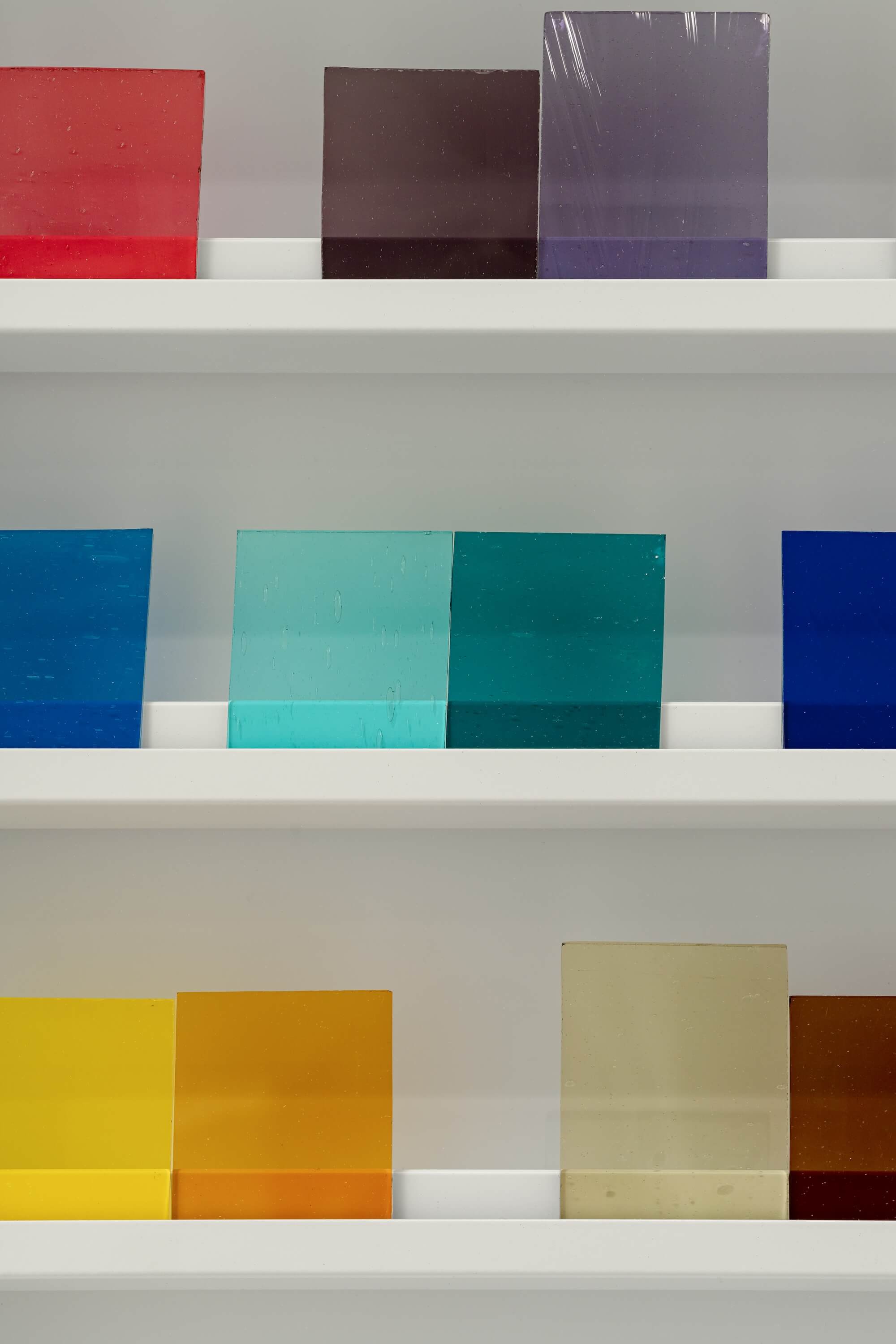
In Meta Painting – Glass Swatches (2025), Kimsooja presents a visual archive of handmade glass samples sourced for her permanent stained-glass installation, commissioned on the occasion of the 800th anniversary of the Cathédrale Saint-Étienne de Metz. The glass pieces—carefully selected for their light and textural qualities—reflect the artist’s interest in "non-doing" and “non-making,” where the absence of overt production gives way to the presence of its inherent qualities. The emphasis shifts from creation to observation, positioning the archive as a vessel of material reality and painterly practice.
Photo by Shim Kyuho
Installations at Studio Kimsooja, Seoul
Kimsooja, Meta Painting – Glass Swatches, 2025, glass, 36.3 x 93.5 x 6 cm
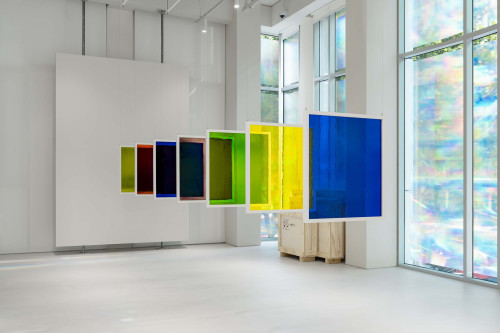
Meta Painting – Seven Colors | 2025
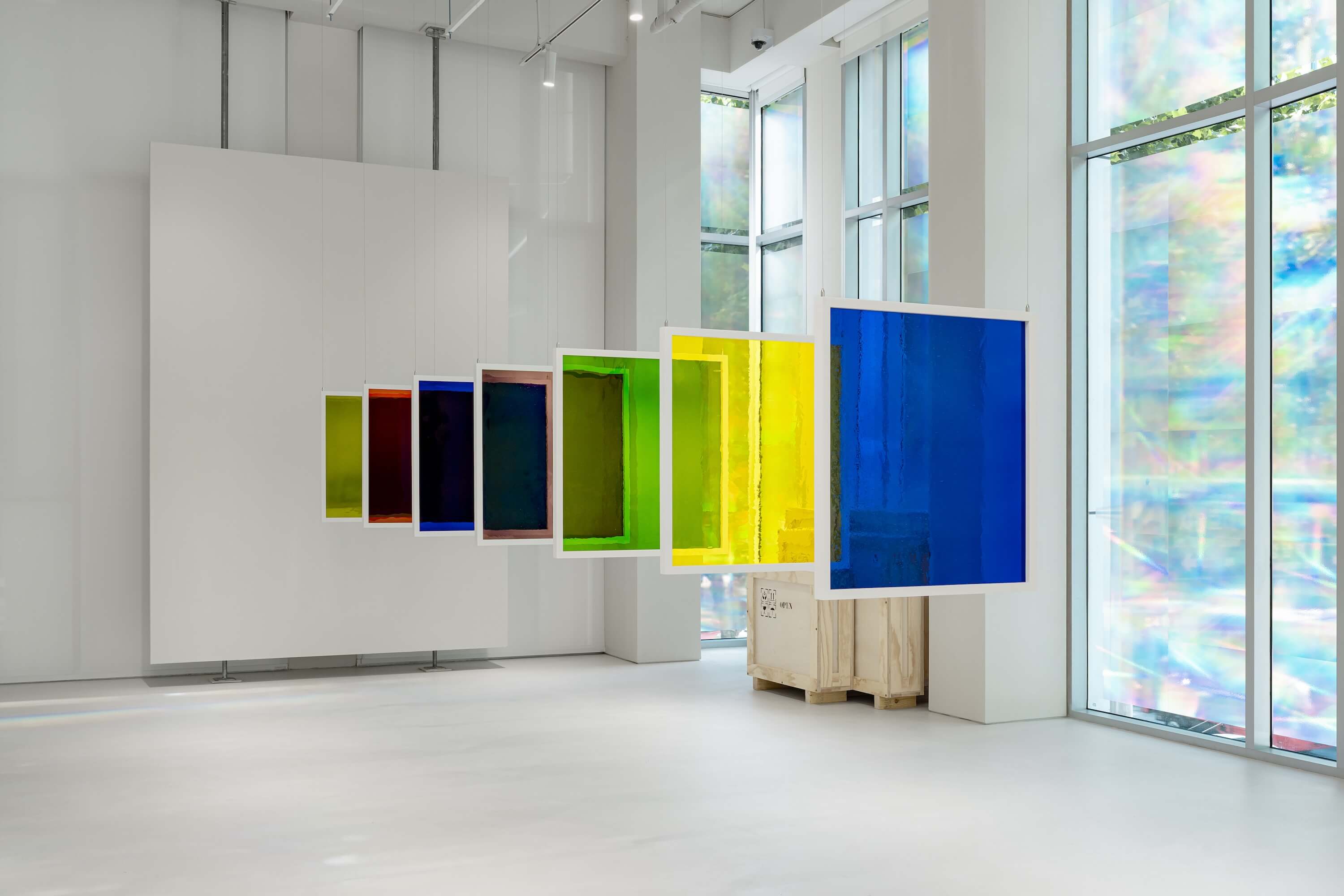
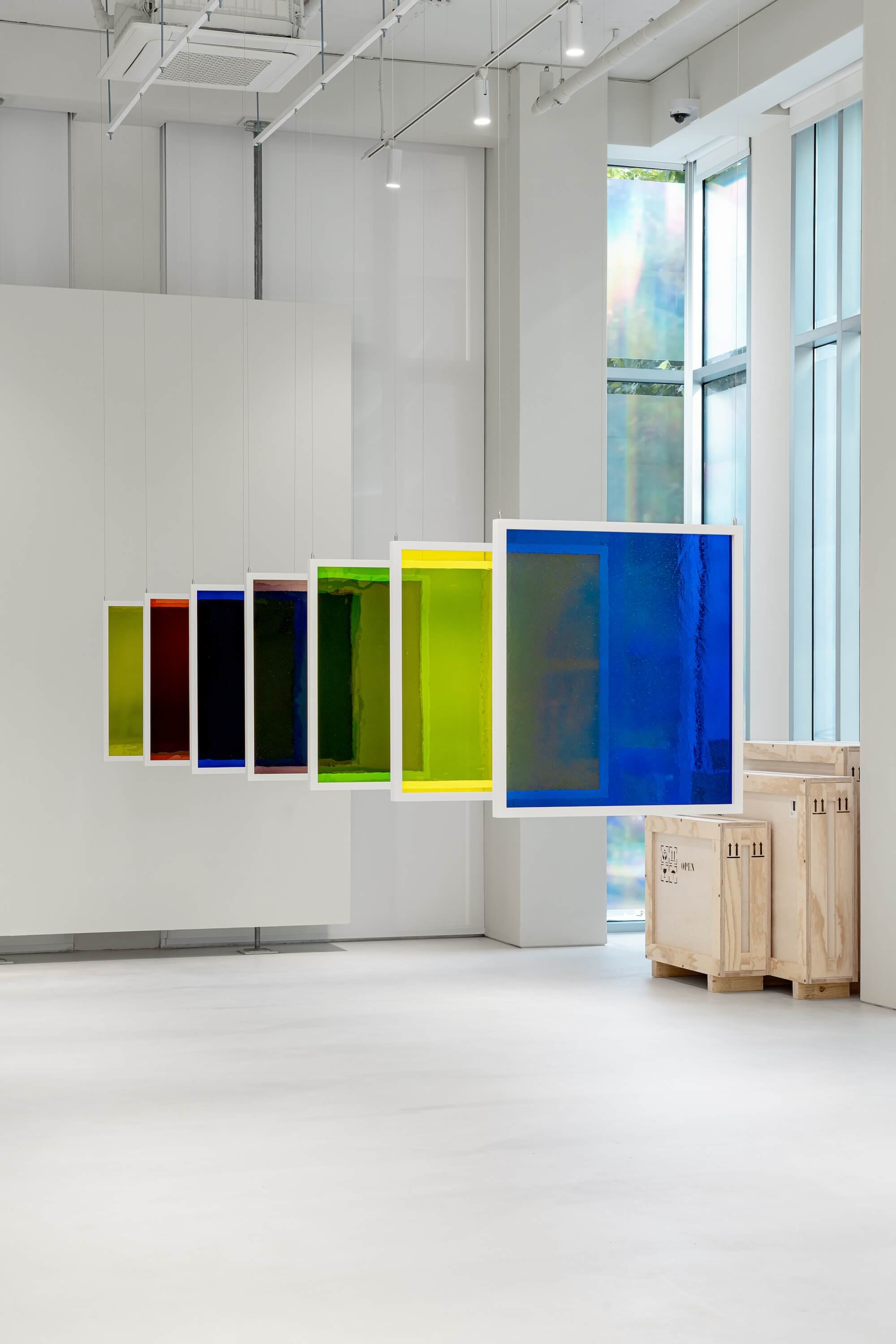
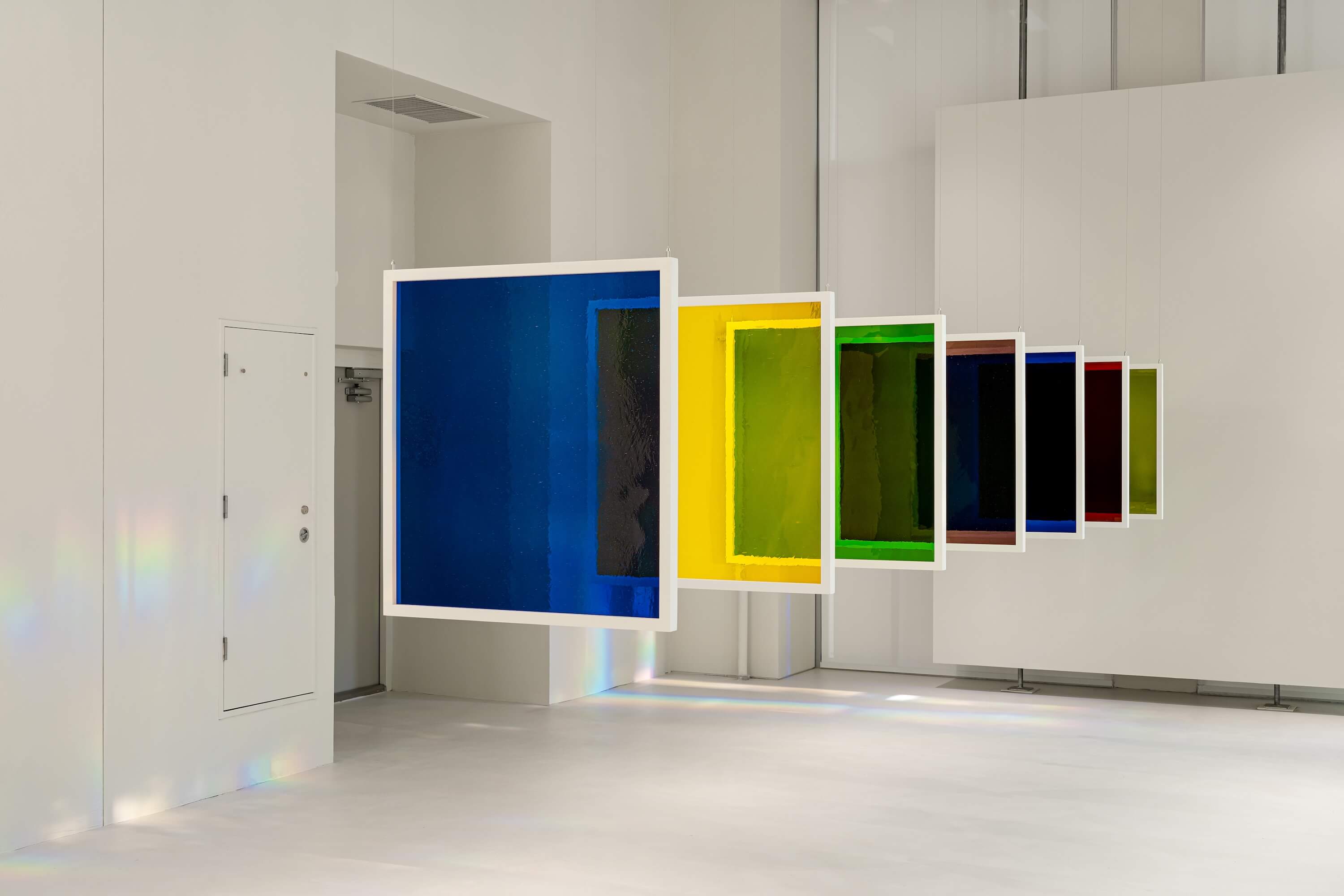
Meta Painting – Seven Colors
Meta Painting – Seven Colors (2025)
In this work, Kimsooja suspends a sequence of vertically aligned glass panels, each rendered in a distinct color, which overlap to dissolve into a final black hue. The convergence of chromatic differences into black extends her inquiry into unity, void, and transcendence, recalling her earlier use of color as mediation between spectrum and convergence. Her sustained exploration of ‘non-doing’ and ‘non-making’—as the glass panels remain unaltered two-dimensional planes—opens onto a spatial expansion into a three-dimensional vacuum, where minimal intervention transforms into a contemplative field that enfolds light, color, and perception. In doing so, Kimsooja expands the traditional notion of painting, reconfiguring the surface into an ever-changing chromatic field.
Photo by Shim Kyuho
Installations at Studio Kimsooja, Seoul
Kimsooja, Meta Painting – Seven Colors, 2025, glass, each 80 x 73 cm
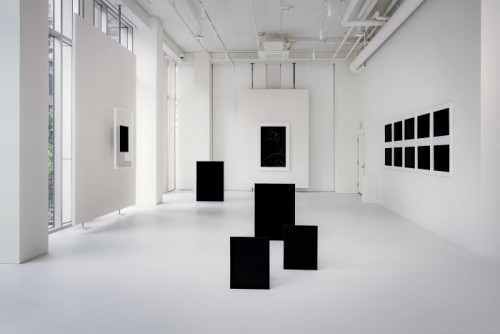
Meta-Painting series | 2024
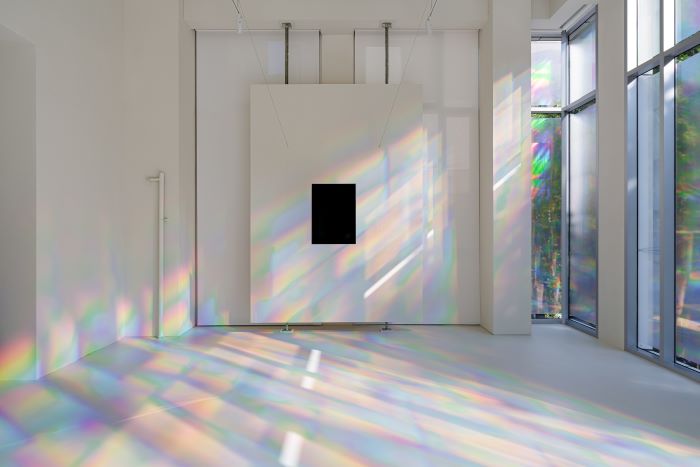
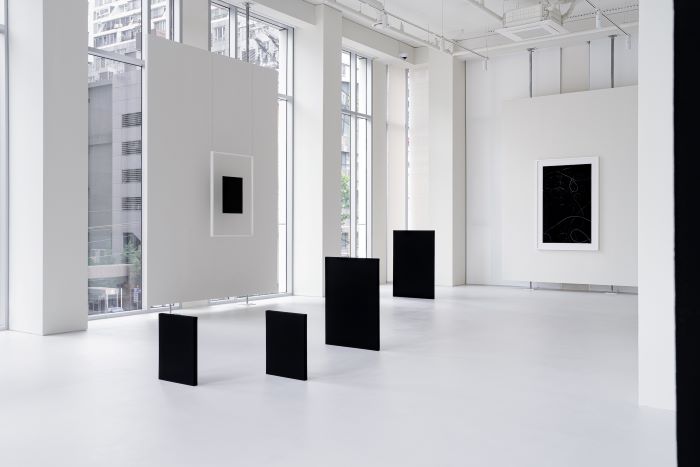
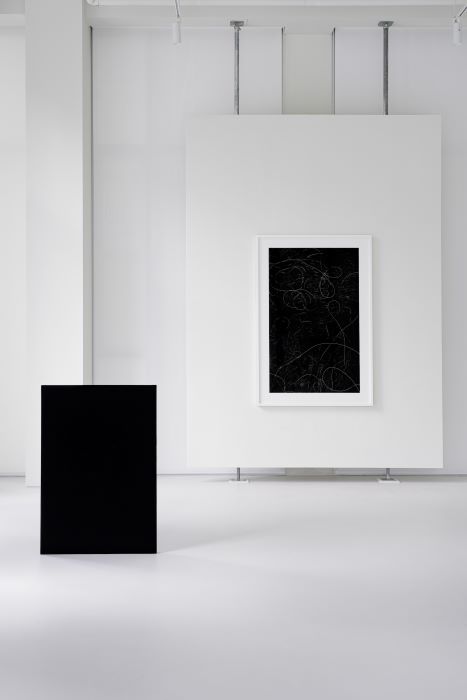
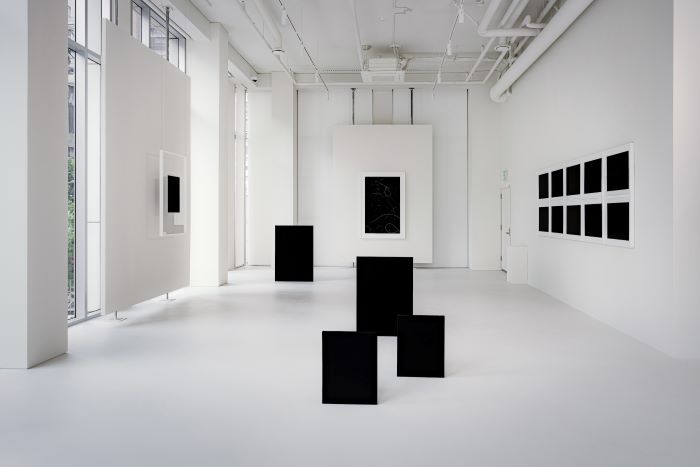
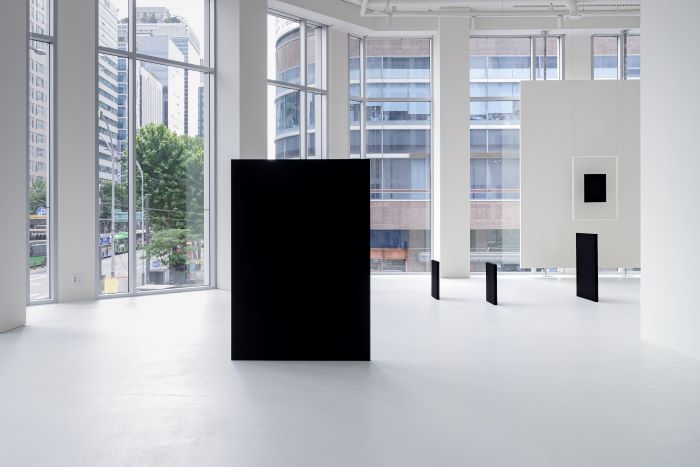
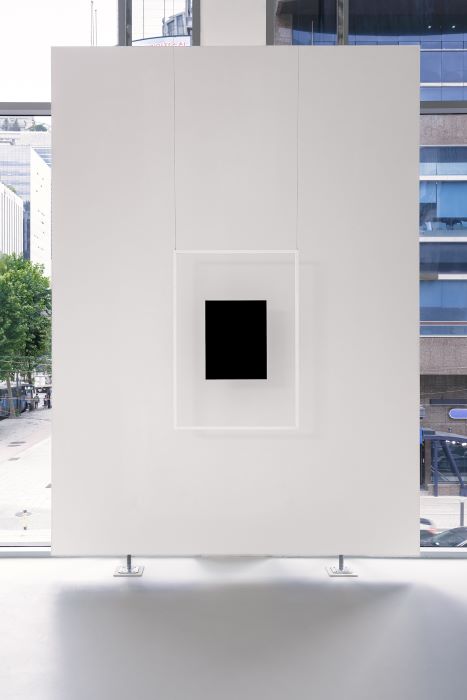
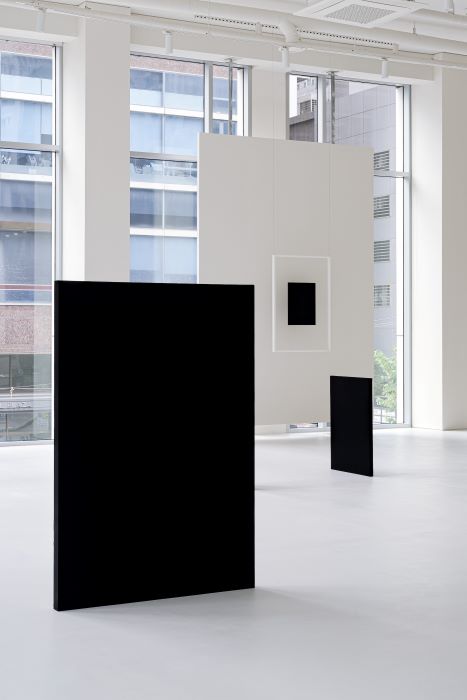
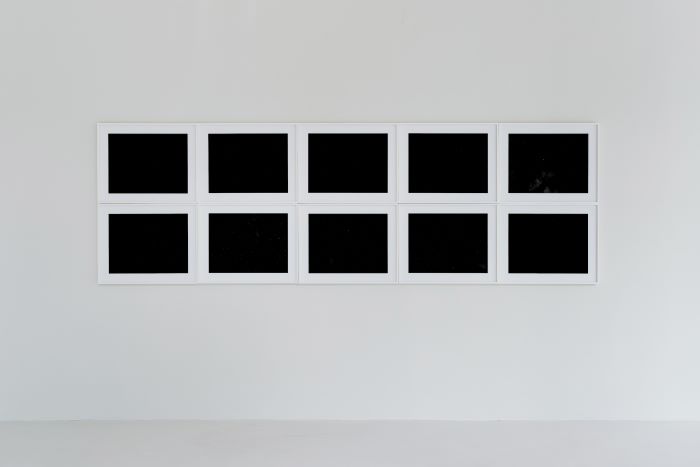
Meta-Painting series
Meta-Painting (2020) started as an exploration into the origins and fundamental principles of painting at Wanås Konst Sculpture Park in Sweden, where Kimsooja planted, cultivated, and harvested flax. While the flax fibers were woven into linen canvas (the surface of oil paintings), its seeds were made into linseed oil (a key solvent in oil paint). Through the cultivation and harvesting of flax, the project reconstructed painting as a life-generating cycle —a notion that has been integral to Kimsooja’s practice since the beginning of her career as a painter. With Meta-Painting (2020), Kimsooja proposed a conceptual relationship between the unpainted canvas, agriculture and textiles, a recurring theme that can be traced back to works such as Agriculture from 1988, establishing a form of painting that transcends the traditional act of painting itself.
Kimsooja’s black Meta-Painting (2025) series extends this notion of ‚non-doing’ that both resists and stores markers of time. The works take form as both a flat and multidimensional surface, composed of countless invisible layers of sprayed dots, continuing the formalistic trajectory of Kimsooja’s folded and unfolded Bottari: fabric bundles which embody the act of wrapping people’s lives and memories. While the depth of black color absorbs nearly all traces of light and shadow, its surface resists our discernment. The series thus conceptualizes and brings to reality the absence of light, encapsulating both the void and the sum of all colors. Much like light, which manifests as localized particles and all-encompassing waves, Kimsooja's Meta-Painting (2025) superimposes states of presence and absence, life and death, revealing that what seems absent can still hold the entirety of what exists.
〈메타-페인팅〉(2020)은 스웨덴 바노스 콘스트 조각공원(Wanås Konst Sculpture Park)에서 김수자가 아마(flax)를 직접 심고 재배하며 수확하는 과정을 통해 회화의 기원과 근본 원리를 탐구하는 프로젝트로 시작되었다. 아마 섬유는 린넨 캔버스로 짜였고, 씨앗은 유화 물감의 주요 용제인 린시드 오일로 만들어졌다. 아마를 경작하고 수확하는 과정을 통해서 이 프로젝트는 회화를 생명 생성의 순환 과정으로 재구성했는데, 이는 김수자가 화가로서의 경력 초창기부터 지속해 온 중요한 사유이기도 하다. 〈메타-페인팅〉(2020)을 통해 김수자는 채색되지 않은 캔버스, 농경, 텍스타일 사이의 개념적 관계를 제시했는데, 이는 1988년 작 〈농경〉 등 초기 작업으로까지 거슬러 올라가는, 자주 등장해 온 주제다. 이로써 작가는 전통적인 ‘그리는 행위’를 넘어서는 새로운 형식의 회화를 구축한다.
김수자의 〈메타-페인팅〉(2025) 흑색 회화 연작은 시간의 흔적을 품으면서도 그에 저항하는 ‘비-행위(non-doing)’의 개념을 더욱 확장한다. 이 작품들은 수많은 보이지 않는 분사(噴射) 점층들이 겹겹이 쌓여 이루어진 평면이자 다차원적 표면들로 구성되며, 접고 펼쳐지는 보따리 – 사람들의 삶과 기억을 감싸는 행위를 내포한 천 보따리 – 의 형식적 궤적을 잇는다. 검은색의 깊이는 거의 모든 빛과 그림자를 흡수하지만, 그 표면은 우리의 시각적 판독을 거부한다. 따라서 이 연작은 빛의 부재를 개념화하고 그것을 실재를 통해 구현함으로써 ‘비어 있음’과 모든 색의 총합을 동시에 담아낸다. 미세한 입자이면서도 모든 곳에 파동으로 퍼지는 빛처럼, 〈메타-페인팅〉(2025)은 존재와 부재, 삶과 죽음이라는 상태를 겹쳐서 보여준다. 그 결과, 비어 있는 것처럼 보이는 자리에도 존재의 총체가 머무를 수 있음을 시사한다.
Photo by Shim Kyuho
Installations at Studio Kimsooja, Seoul
(Left to Right:)
1 Kimsooja, Meta-Painting, 2024, Black paint on glass, 160 x 112 cm
2 Kimsooja, To Breathe, 2024, Site-specific installation with diffraction grating film, Dimensions variable
3 Kimsooja, Meta-Painting, 2024, Black paint on linen canvas, 162.2 x 112.1 x 6 cm
4 Kimsooja, Meta-Painting, 2024, Black paint on linen canvas, 53 x 40.9 x 4 cm
5 Kimsooja, Meta-Painting, 2024, Black paint on linen canvas, 53 x 40.9 x 4 cm
6 Kimsooja, Meta-Painting, 2024, Black paint on linen canvas, 90.9 x 65.1 x 4 cm
7 Kimsooja, Meta-Painting, 2024, Black paint on linen canvas, 116.8 x 80.3 cm
8 Kimsooja, Meta-Painting, 2024, Black paint on glass, 116.7 x 80.3 cm
9 Kimsooja, Sewing into Darkness, 2023, Archival pigment print, each 59 x 74cm
10 Kimsooja, Topology of Time, 2016, Giclée (Inkjet) Print, Print: 170.5 x 114.1 cm, Image: 147.9 x 91.4 cm
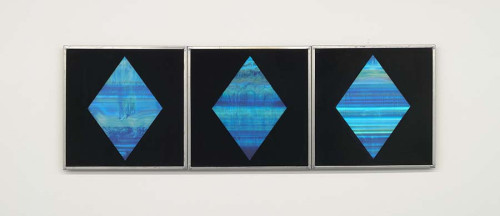
Meta-Painting, 2019-2023
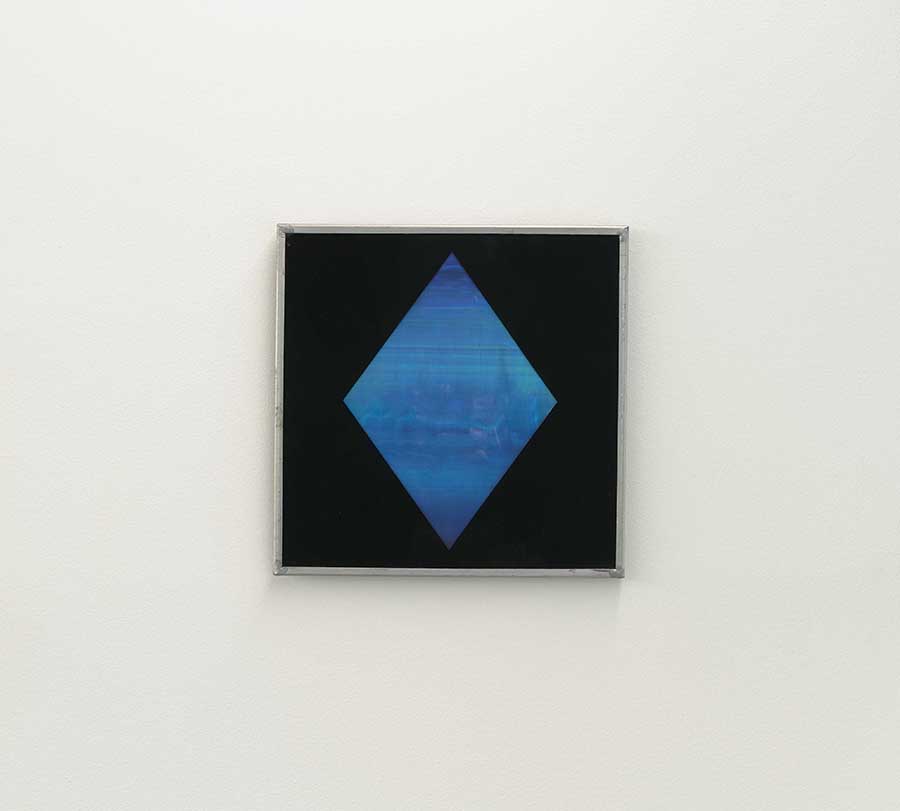
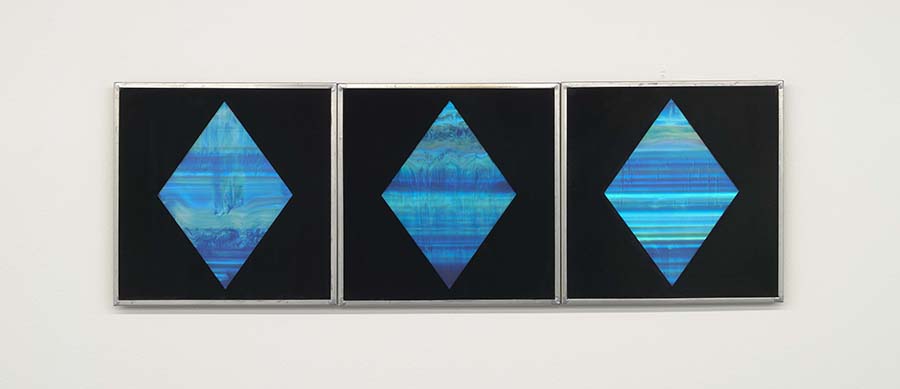
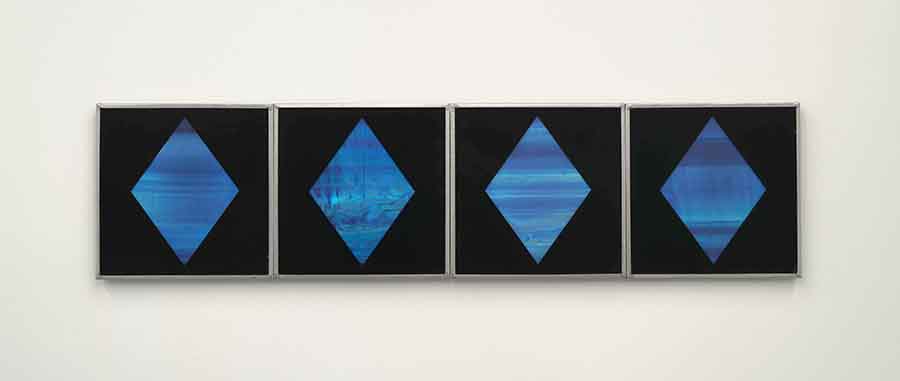
Meta-Painting, 2019-2023
The diamond shapes also have a Buddhist connotation, in the sense of seeking self-completion. In Patio Gallery's small exhibition room are three additional works titled Meta-Painting. The paintings dynamically encapsulate natural light across the visible spectrum by refracting different wavelengths of light through specific undulation of molecular structure. What results is an iridescent material fabric, woven in light. Kimsooja first used nanopolymer in 2014 for the work "A Needle Woman: Galaxy was a Memory, Earth is a Souvenir". In close collaboration with Ulrich Wiesner, nanomaterials engineer and chemist at Cornell University, Stephanie Owens, curator, and architect Jaeho Chong, the artist created a 14-meter-high needle-shaped nanopolymer steel structure. With a mirrored floor, the environment within the sculpture is remarkable as its space appears simultaneously to extend deep into the earth and to reach high into the sky.
The use of intricate, nano-scale materials demonstrates the reflective characteristics of natural sunlight. The structure's grid-like, sleek, volumetric spine is fleshed out with acrylic panels to form a crystalline pavilion that is transparent to direct view. At a raking light, each of the panels, which have been individually treated with an iridescent nanopolymer, transforms the transparent pavilion into a radiant spectrum with colour as the polymer refracts various wavelengths of natural light dependent on the angle from which it is viewed. Like iridescence that occurs in nature on the wings of butterflies or shells of beetles, the colour of the pavilion is physically interactive, where the blue, red, orange, pink, yellow, green, violet, and other spectral colours appear as a radiant glitch in the fabric of reality. These colours were expressed by using the refraction of light itself in the molecular structure rather than by pigments.
Materialising the shapes, colours, and effects of nature's beauty, Kimsooja considers the earth as a memory. So, too, do the works exhibited in To Breathe - Archive of Prototype, connecting the elusive realms of science and technology with artistic, cultural, and philosophical components from global life.
Meta-Painting
2019-2023, Nanopolymer Glass, Black Lead Paint, Lead
each 17.5 x 17.5 x 0.5 cm
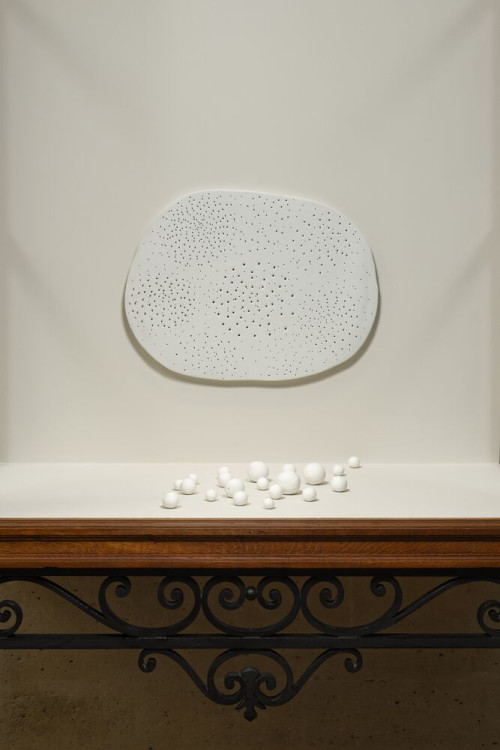
Sewing into Soil: Invisible Needle, Invisible Thread, 2023 / Deductive Object, 2019
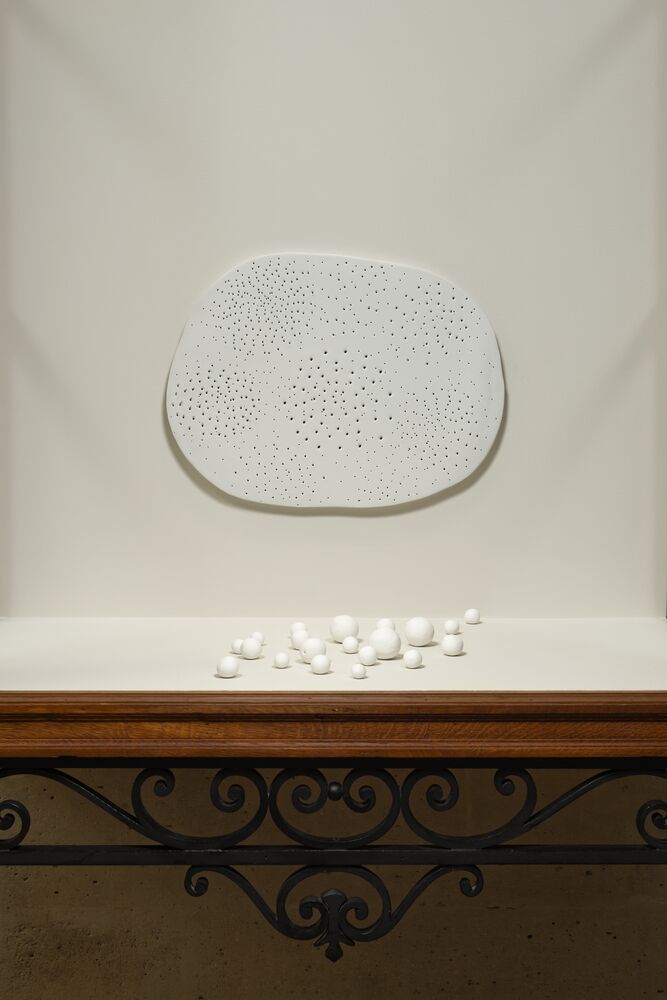
Sewing into Soil: Invisible Needle, Invisible Thread, 2023 / Deductive Object, 2019
Sewing Into Soil: Invisible Needle, Invisible Thread, 2023
Porcelaine
Courtesy Kimsooja Studio; KEWENIG, Berlin; Staatliche Museen zu Berlin, Museum für Asiatische Kunst, Berlin, Staatliche Porzellan-Manufaktur Meissen, Germany
–
Deductive Object, 2019
Porcelaine
Courtesy Kimsooja Studio et Manufacture de Sèvres – Cité de la Céramique
In Sewing Into Soil: Invisible Needle, Invisible Thread Kimsooja needles a slab of porcelain as if sewing into a fabric. The needle doubles as a paint brush and shapes an irregular surface that registers the artist’s physical action. Like on a landscape, or a freshly planted field, she associates the act of piercing into the porcelain mass with that of sowing seeds in the earth.
The porcelain balls of Deductive Object form through contrasting forces of the body. When making them, the two palms press into and rotate about a center, a point of gravitational pull, where the earthen matter absorbs the temperature and temperament of the person shaping it. The two works seen side by side draw a field of voids out of spheres, both contained and empty.
–
〈흙으로 바느질하기: 보이지 않는 바늘, 보이지 않는 실〉에서 김수자는 도자판을 천을 꿰매듯 바늘로 찌르고 꿰뚫는 행위를 수행한다. 이 바늘은 동시에 붓처럼 기능하며, 작가의 신체적 행위가 고스란히 새겨진 불규칙한 표면을 만들어낸다. 마치 풍경 위에 자국을 남기거나 막 파종을 마친 밭고랑을 형성하듯, 작가는 도자 덩어리를 관통하는 바느질을 땅에 씨앗을 심는 행위와 겹쳐 사유한다.
〈연역적 오브제〉의 도자 구체는 신체의 상반된 힘을 통해 형성된다. 양손은 흙의 중심점을 향해 눌러붙고 회전하며, 그 중력의 중심에서 흙덩어리는 이를 빚는 사람의 체온과 기질을 흡수한다. 나란히 놓인 두 작품은 비어 있으면서도 품고 있는, 공백의 장을 그려낸다.
View of the exhibition To Breathe – Constellation, Bourse de Commerce – Pinault Collection, Paris, 2024.
© Tadao Ando Architect & Associates, Niney et Marca Architectes, agence Pierre-Antoine Gatier.
Photo: Aurélien Mole / Pinault Collection.
© Kimsooja/ADAGP, Paris, 2024.
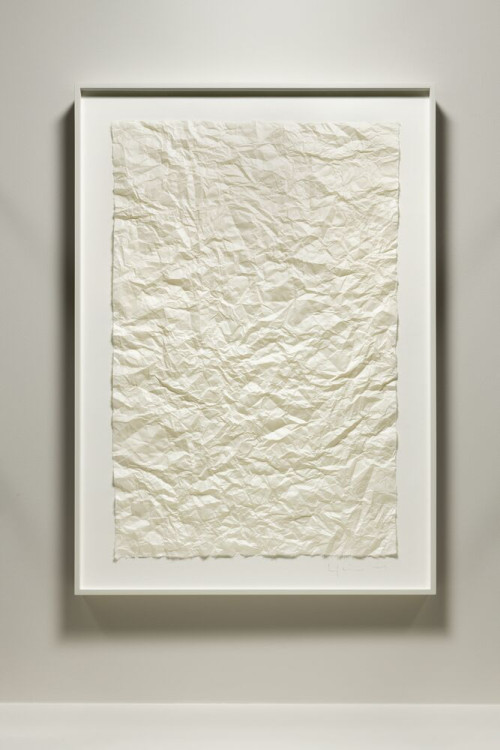
Deductive Object : (Un)fold, 2023
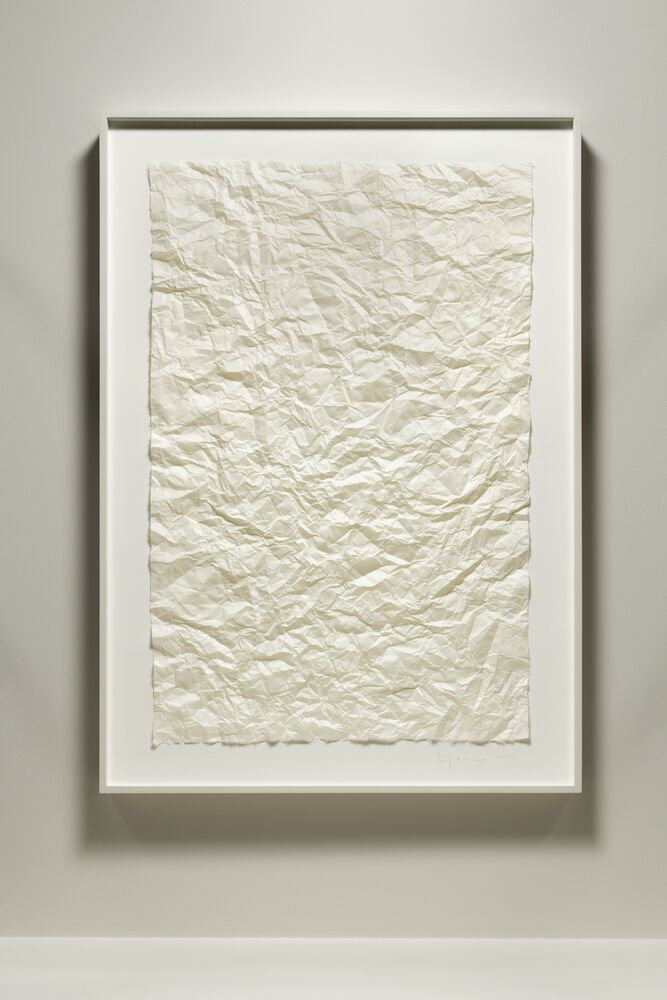
Deductive Object : (Un)fold, 2023
Deductive Object : (Un)fold, 2023
Papier de riz coréen / Korean rice paper
Courtesy Kimsooja Studio et Axel Vervoordt Gallery, Anvers / Hong Kong
–
The artist hand-pressed a sheet of hanji (traditional Korean rice paper) into a ball and then unfolded it back into a surface. The geometry of her hand and sphere translates into a landscape-like vertical dimension. In a sense, the work mirrors itself at a different state of existence. As if folding and unfolding fabric into a bottari, Kimsooja couples the structure of painting with that of sculpture in one continuum.
작가는 한 장의 전통 한지를 손으로 단단히 쥐어 구체로 만든 뒤, 다시 펼쳐 평면의 표면으로 되돌렸다. 손과 구의 기하학적 형태는 펼쳐진 한지 위에서 마치 풍경을 닮은 수직적 차원으로 전환된다. 어떤 의미에서 이 작업은 하나의 존재가 여러 상태로 존재하며 스스로를 비추는 구조를 지닌다. 천을 접고 펼쳐 보따리로 만드는 과정처럼, 김수자는 회화의 구조와 조각의 구조를 하나의 연속체 안에서 결합한다.
View of the exhibition To Breathe – Constellation, Bourse de Commerce – Pinault Collection, Paris, 2024.
© Tadao Ando Architect & Associates, Niney et Marca Architectes, agence Pierre-Antoine Gatier.
Photo: Aurélien Mole / Pinault Collection.
© Kimsooja/ADAGP, Paris, 2024.
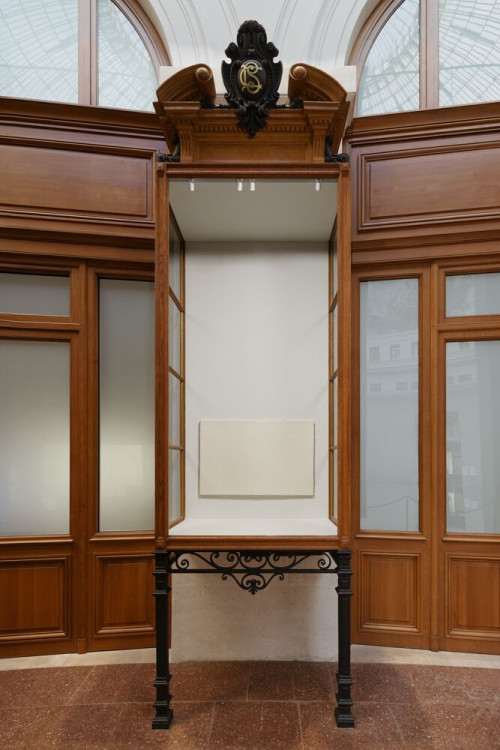
Meta Painting | 2022
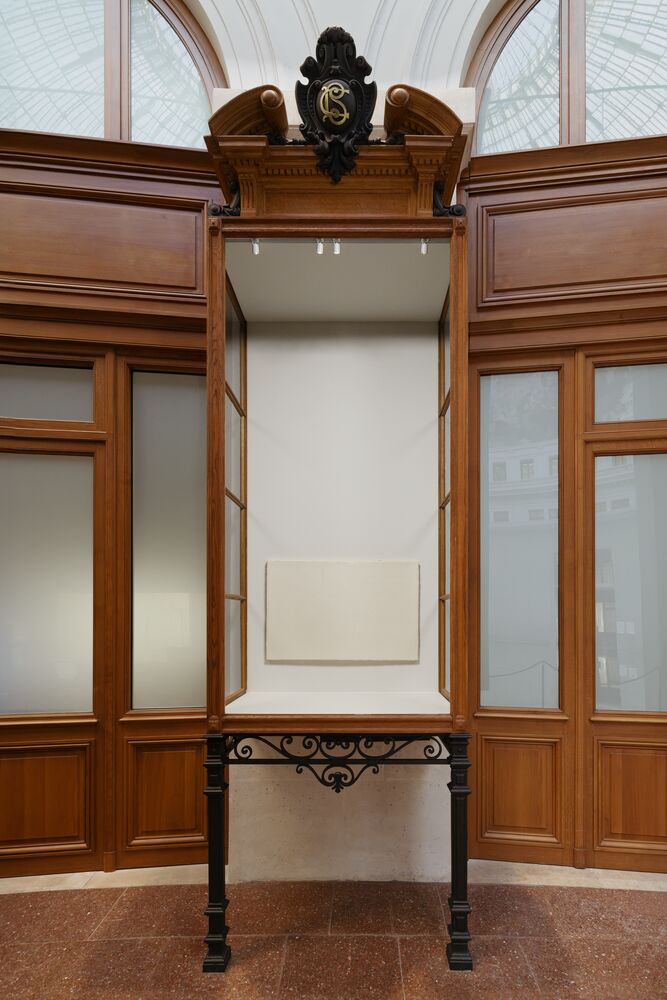

Meta Painting
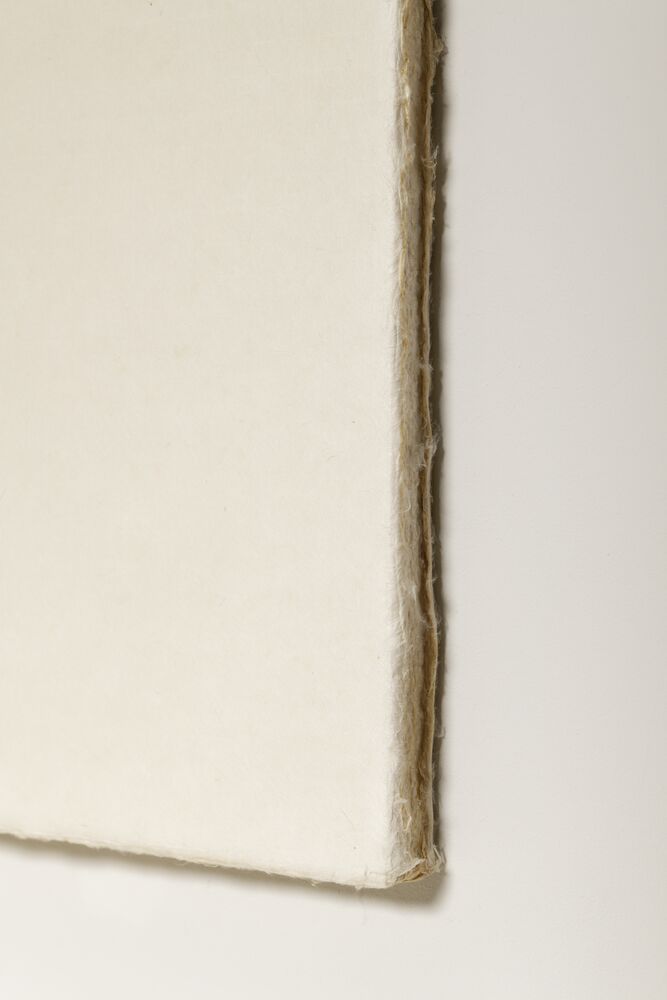
Meta Painting, 2022
250 feuilles de papier de riz coréen / 250 Sheets of Korean rice paper
Courtesy de Kimsooja Studio et Axel Vervoordt Gallery, Anvers / Hong Kong
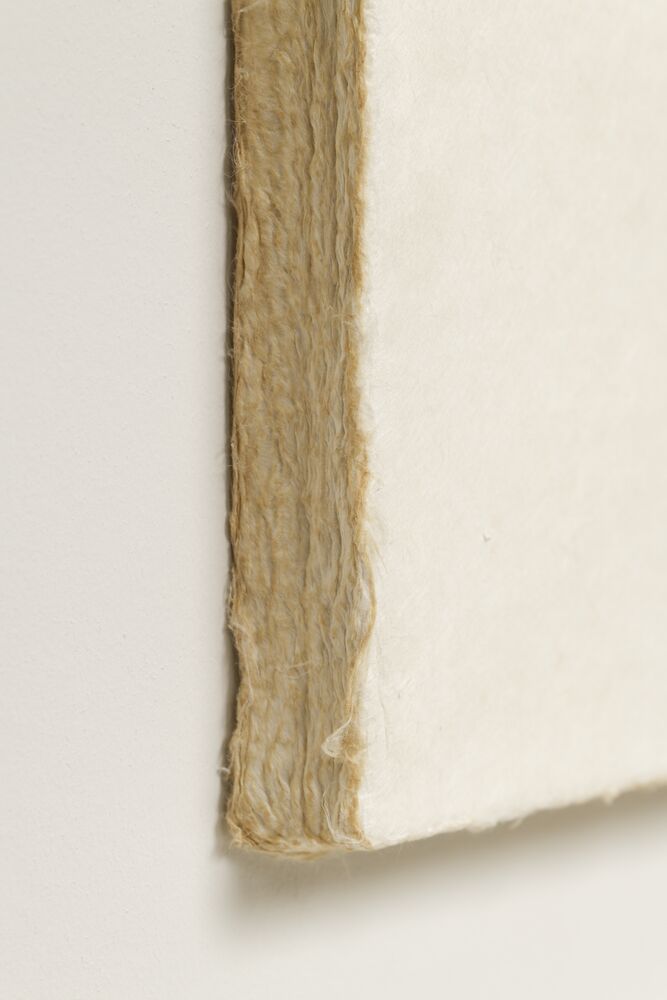
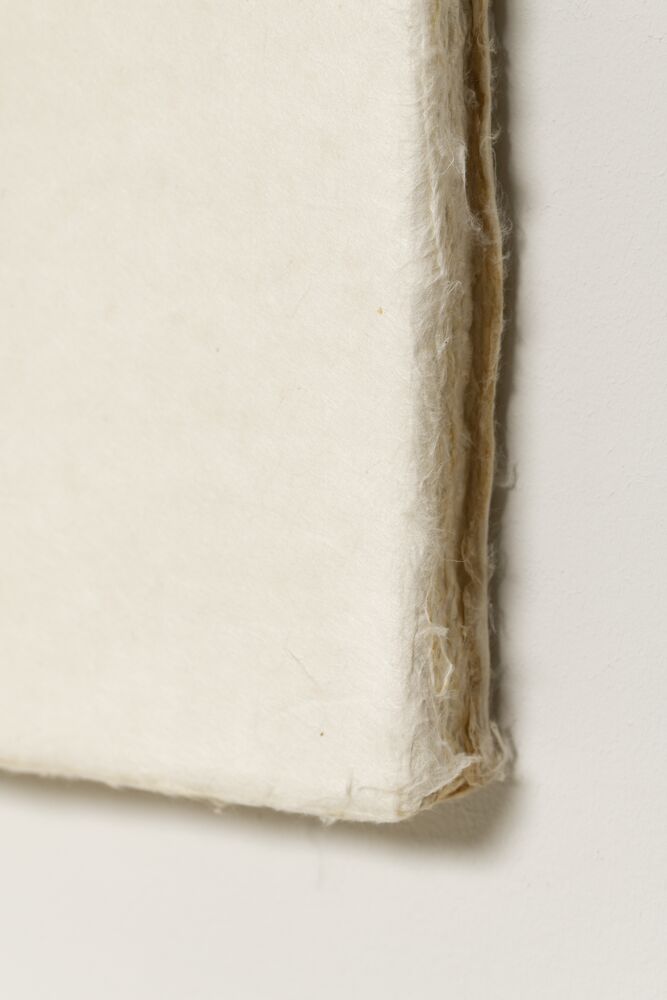
Kimsooja is first and foremost a painter. She approaches all of her work through a set of questions that originate in the act of painting on the surface of canvas. The cruciform, or the horizontal and vertical weave supporting the structure of painting remains a foundation upon which Kimsooja builds her artistic language. This work is made up of 250 sheets of hanji (traditional Korean rice paper) stacked into a single layer. Like a woven canvas, hanji is made by sifting a bath of dak tree fibres with a wooden sieve in vertical and horizontal directions. It is the result of a geometric performance. This painting-object, a manifestation of countless fibers intersecting in axial directions, reflects the artist’s vision of the world as a vast weave and a tableau undone.
–
김수자는 무엇이든 회화에서 출발하는, 그야말로 화가이다. 그녀는 모든 작업은 캔버스 표면에 그려 나가는 회화 행위에서 비롯된 일련의 질문에서부터 뻗어 나간다. 그렇기에 회화를 지탱하는 수평과 수직의 직조, 즉 십자 형태의 구성은 여전히 김수자의 예술 언어를 구축하는 기반으로, 그녀의 예술 언어를 구축하는 토대가 된다. 이 작품은 전통 한지 250장을 하나의 평면으로 층층이 쌓아 구성된 것이다. 가로세로의 방향으로 실이 교차되며 캔버스가 직조되듯, 한지도 닥섬유를 물 위에서 수직과 수평 방향으로 건져 올리는 기하학적 퍼포먼스를 통해 만들어진다. 수많은 섬유가 축을 따라 교차하며 탄생한 이 회화적 오브제는, 세계를 거대한 직조물이자 풀려버린 하나의 장면으로 바라보는 작가의 시선을 반영한다.
View of the exhibition To Breathe – Constellation, Bourse de Commerce – Pinault Collection, Paris, 2024.
© Tadao Ando Architect & Associates, Niney et Marca Architectes, agence Pierre-Antoine Gatier.
Photo: Aurélien Mole / Pinault Collection.
© Kimsooja/ADAGP, Paris, 2024.
Geometry of Body, 2006-2015
Geometry of Body, 2006-2015
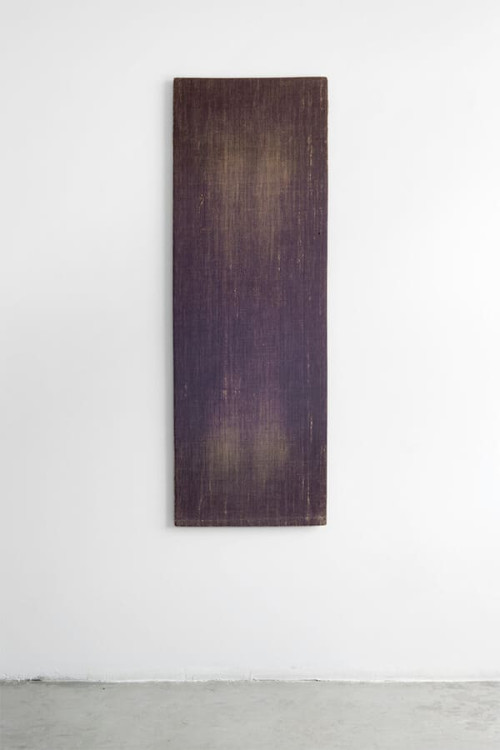
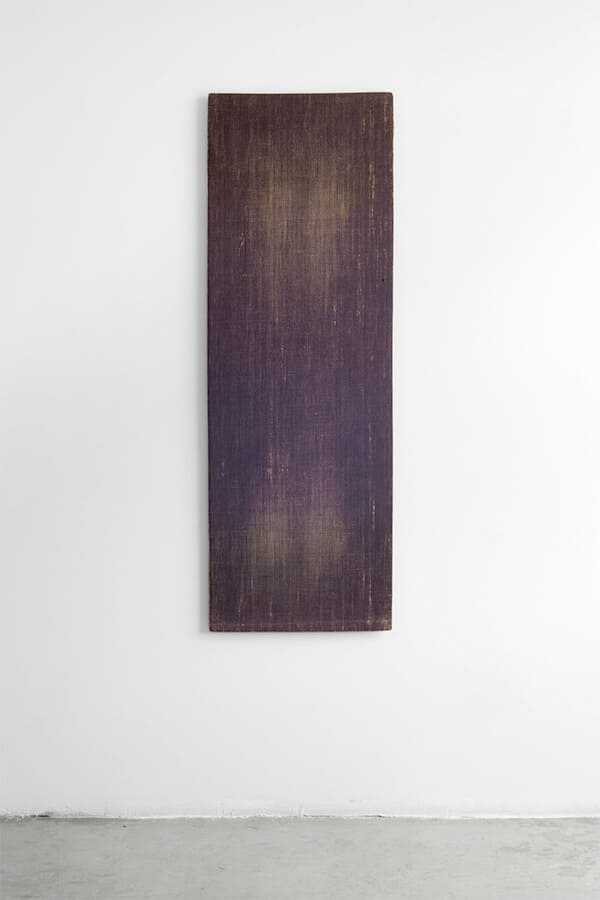
Rubber, Jute, and Natural Cotton - Used Artist's Yogamat
182.9 x 60.9 cm
Unique
Courtesy Kimsooja Studio et KEWENIG, Berlin
–
Kimsooja practiced yoga on this mat from 2006 to 2015. The traces of her hands and feet, the geometric movements of the body, the forces of gravity, and accumulated time become palpable on this enigmatic surface of fabric, which serves as a tableau vivant. This piece is a continuation of the artist’s study on body and its geometric form that began in the early 1980s.
김수자는 2006년부터 2015년에 이 요가 매트를 사용하며 수행을 지속했다. 손과 발의 자취, 신체가 그려낸 기하학적 움직임, 중력의 힘, 그리고 축적된 시간들은 직물의 표면 위에 고스란히 각인되며, 하나의 ‘타블로 비방(tableau vivant)’, 즉 살아 있는 회화으로 기능한다. 이 작품은 1980년대 초부터 작가가 시작한 신체와 기하학적 형상에 관한 연구의 연장선에 있다.
Photo by Aaron Wax
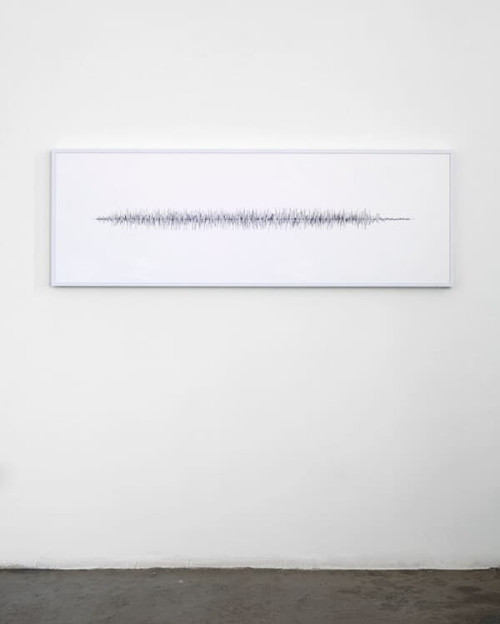
One Breath, 2004/2016
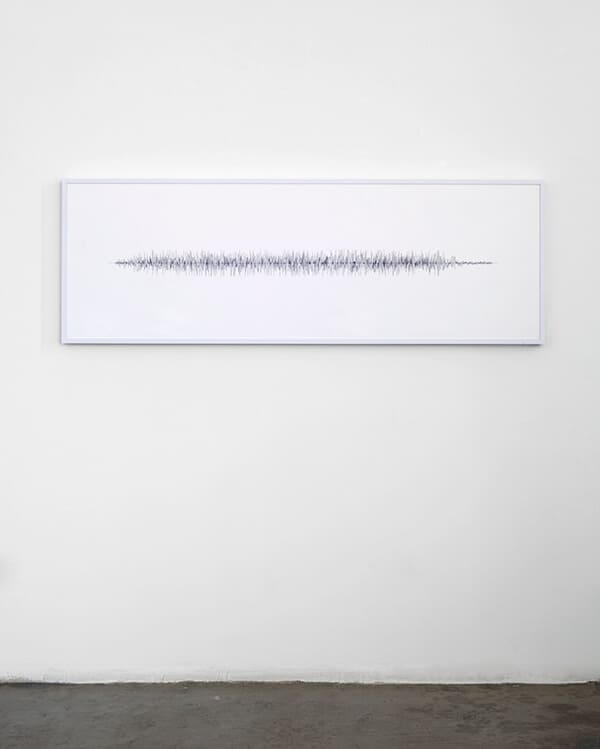
One Breath, 2004/2016
숨 One Breathe
Digital Embroidery on Satin, abstract from The Weaving Factory(2004) sound performance by the artist,
61.4 x 179.5 x 7 cm
Unique
–
<숨>은 작가가 바느질을 중단한 1992년 이후 처음으로 제작한 디지털 자수 작품이다. 이 작품은 호흡 사운드 퍼포먼스 <직물 공장>의 음파 그래픽의 한숨을 디지털 자수로 수놓은 것이다. 들숨과 날숨이 만들어 내는 파동은 직물 사이를 누비는 바느질을 통하여 그 구조와 형식을 보여 주며, 음과 양, 삶과 죽음의 순환을 시각적으로 형상화한다.
–
One Breath is the first digital embroidery piece Kimsooja made since she stopped her sewing practice in 1992. One segment of sound wave from her breathing performance The Weaving Factory is sewn across the canvas, tracing the cyclical act of inhaling and exhaling across life and death.
Photo by Aaron Wax